Why Does Torrance Call Itself “A Balanced City”? |
The familiar civic motto reflects a founding plan to place homes, businesses, industry and public spaces within one carefully designed community. |
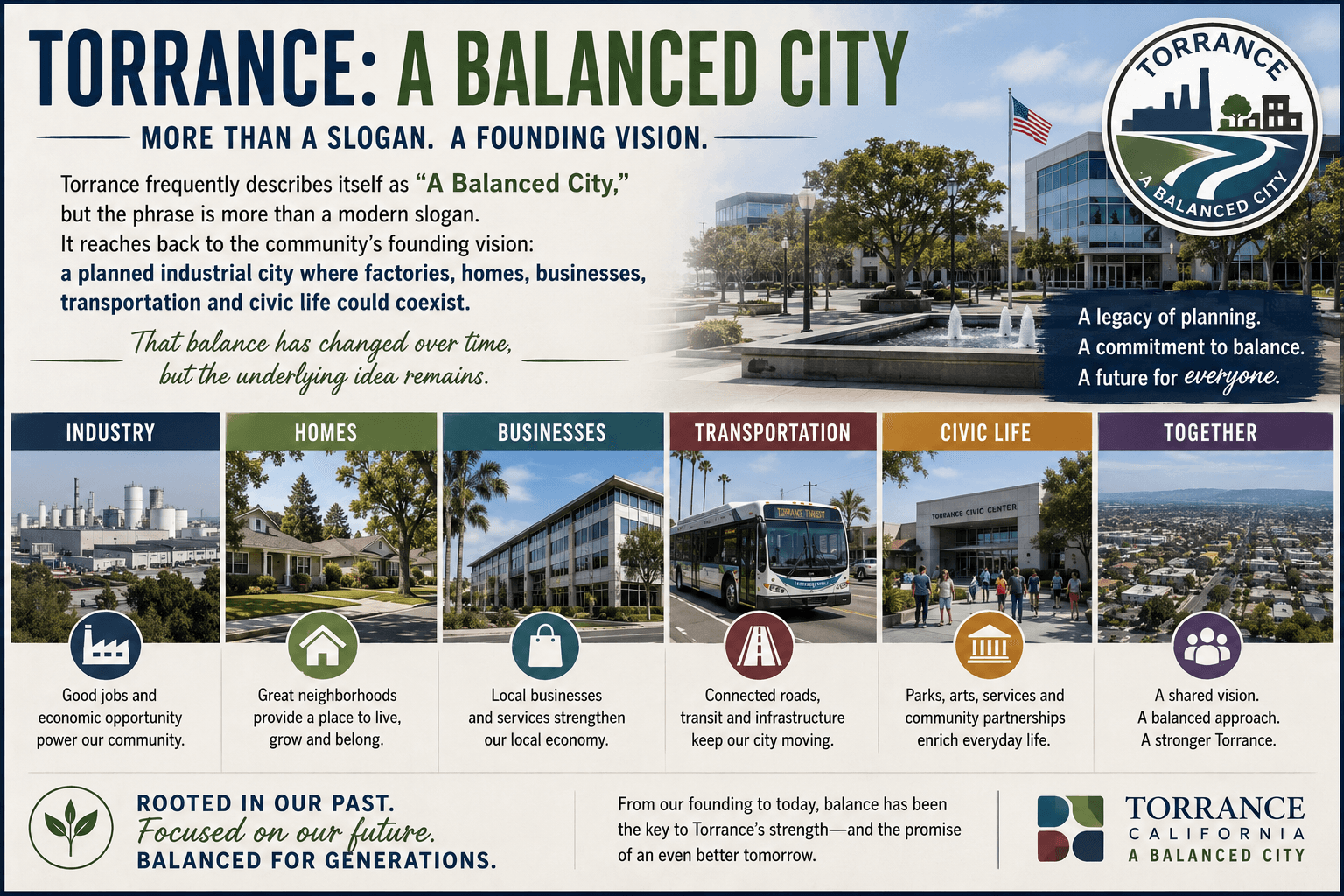
The words “A Balanced City” appear throughout Torrance, but many residents may never have stopped to consider what they mean.
The phrase refers to Torrance’s original design as a deliberately planned community—not simply a collection of neighborhoods that gradually expanded without an organizing vision.
Industrialist Jared Sidney Torrance began assembling land for the new community around 1910. His goal was to establish a modern industrial city between Los Angeles and the harbor, where major employers could operate near thoughtfully planned residential neighborhoods.
That was the first form of Torrance’s intended balance: industry and employment on one side, homes and community life on the other.
The Dominguez Land Corporation hired the nationally prominent landscape-planning firm Olmsted and Olmsted to prepare the town plan. Architect Irving J. Gill designed several of the early civic and industrial buildings, while Lloyd Wright contributed to landscaping work.
The original plan separated different uses while connecting them through streets, landscaped areas and transportation routes. Industrial facilities were positioned near railroad access, while workers’ homes, businesses, parks and civic buildings formed the broader community.
The word “balanced” did not mean that every part of Torrance would be equal in size. It meant that the city would contain the different ingredients needed to function independently: jobs, housing, transportation, commerce, public institutions and recreation.
That vision evolved as Torrance grew. During the postwar decades, large residential developments expanded across the western and southern portions of the city. Retail became increasingly important with the development of shopping centers along Hawthorne Boulevard, including Del Amo. Aerospace, manufacturing and engineering joined the city’s older industrial base.
By the 1960s, Torrance’s “balance” described a mix of manufacturing, aerospace engineering, retail and residential neighborhoods rather than the simpler factory-and-housing model envisioned during the city’s founding.
The concept continues today. Torrance contains large employers, industrial districts, medical centers, shopping destinations, schools, parks, residential neighborhoods and a municipal airport—all within approximately 21 square miles. The city still uses the balanced-city idea when describing its blend of residential, commercial and industrial interests.
Balance does not mean the city is free from conflicts. Industrial operations can affect nearby neighborhoods. New development can create traffic or raise concerns about density. Residents, businesses and city leaders may disagree over how much land should be devoted to housing, employment, retail or public facilities.
Those debates are actually part of the continuing balanced-city question: How can Torrance preserve jobs and economic activity while remaining a desirable place to live?
More than a century after its founding, the motto serves as both a description and an aspiration. Torrance was built around the belief that a city could support industry without becoming only an industrial town—and provide housing without becoming only a bedroom community.
The specific ingredients have changed since 1912, but the central idea remains recognizable: a complete city where people can live, work, shop, learn and spend their free time without leaving the community.
|
0 Comments
Join the conversation
Be the first to comment
Share your thoughts above.