
Why Does Torrance Have Such a Strong Japanese Connection? |
The story began with farms and nurseries—and grew into one of the South Bay’s defining cultural relationships |
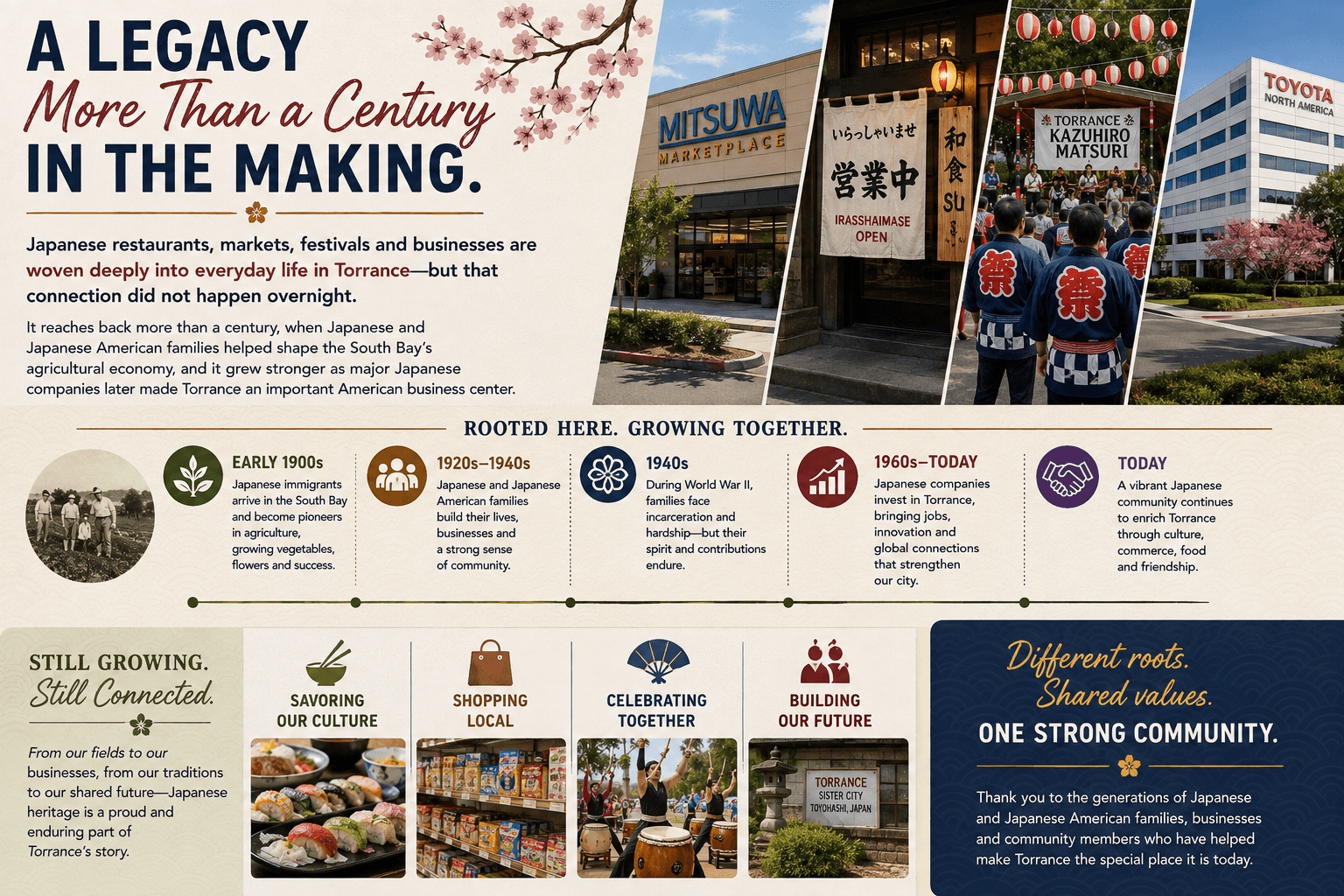
Drive around Torrance long enough and the Japanese influence is impossible to miss.
There are ramen shops, sushi restaurants and Japanese supermarkets. Torrance hosts Japanese cultural festivals and maintains long-standing relationships with communities in Japan. American Honda is headquartered here, and for decades Toyota’s national sales headquarters was here too.
So why Torrance? The answer begins long before the arrival of the automobile companies.
It Started With Farming
Japanese immigrants and Japanese American families were already an important part of the South Bay before World War II.
Agriculture was a major part of the region’s early economy, and Japanese American farmers became especially associated with farms, flower growing and nurseries throughout Torrance, Gardena and the surrounding South Bay.
Historical accounts describe dozens of Japanese American nurseries in the South Bay before World War II, with several operating in North Torrance after the war as well.
That early agricultural community established roots that extended far beyond farming.
Families created businesses, religious organizations, schools and community networks. Oral histories preserved by Densho document generations of Japanese Americans who settled in the South Bay, were forcibly removed during World War II and later returned to rebuild their lives and communities.
World War II Changed Everything
After the attack on Pearl Harbor, Japanese American residents throughout the West Coast were forcibly removed from their homes under federal policy.
Torrance’s own City Council adopted a resolution expressing support for local residents of Japanese ancestry, but the federal government nevertheless removed Japanese heritage families from their homes and farms for incarceration during the war.
For many families, returning afterward meant rebuilding businesses, homes and community institutions from scratch.
Yet the South Bay’s Japanese American community endured.
Then Japanese Business Arrived in a Big Way
A second major chapter began as Japanese companies expanded their American operations.
Toyota opened its national sales headquarters complex in Torrance in 1982, making the city one of the most visible centers of Toyota’s U.S. operations for decades.
American Honda followed with a major Torrance headquarters complex that opened in 1990, consolidating its divisions on one campus. Honda remains deeply rooted in Torrance today.
Those companies brought employees, suppliers, visiting executives and business relationships tied to Japan, reinforcing a cultural connection that was already generations old.
And That Helped Shape the Torrance We Know Today
Over time, those layers began reinforcing one another.
A historic Japanese American population created demand for familiar foods, markets, services and cultural institutions. Japanese corporations brought additional workers and business connections. Restaurants and retailers followed customers. Festivals and community organizations preserved traditions while introducing them to new generations.
Today, that history is visible in everything from Torrance’s Japanese dining scene to cultural festivals, businesses and community celebrations. Discover Torrance describes the city as home to one of the nation’s most significant Japanese and Japanese American communities.
So when you walk into a Japanese market, discover an exceptional ramen shop or attend a Japanese festival in Torrance, you are seeing more than a popular local trend.
You are seeing the modern result of more than a century of immigration, agriculture, hardship, rebuilding, business and community life.
That is why Torrance’s connection to Japan feels so unusually deep.
It is.
|
0 Comments
Join the conversation
Be the first to comment
Share your thoughts above.