
MHow Did Madrona Marsh Survive? |
The story behind Torrance’s unlikely 43-acre urban wetland |
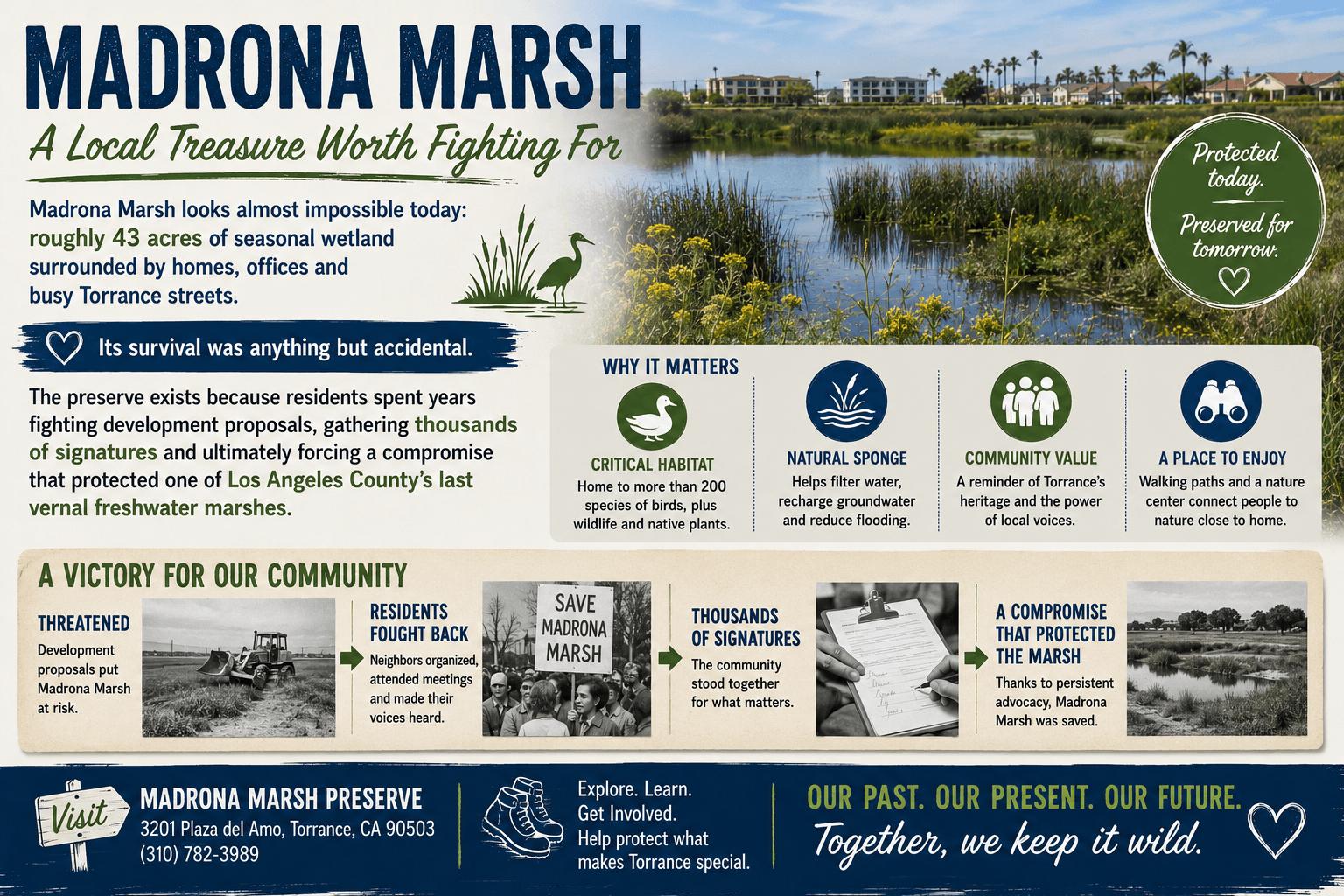
Drive along Sepulveda Boulevard near Madrona Avenue and there is something unusual hiding behind the surrounding cityscape.
Madrona Marsh Preserve is roughly 43 acres of seasonal wetland sitting in the middle of Torrance. It is considered one of the last remaining vernal freshwater marshes in Los Angeles County.
But why is it still there when almost everything surrounding it was developed?
That answer begins with the land itself.
Madrona Marsh occupies a natural depression associated with an ancient coastal dune system. Unlike a lake or permanent pond, a vernal marsh is seasonal. Winter and spring rains collect in the low area, creating pools and wetland habitat. As the weather dries, the water gradually disappears, and by late summer the marsh can be almost completely dry.
For much of the 20th century, the property survived development partly because it was being used for another distinctly Torrance industry: oil production.
Oil wells operated on the property while Torrance grew around it. By the early 1970s, however, the large undeveloped tract had become extremely attractive to builders.
That is when the marsh’s future became uncertain.
Residents began organizing to preserve the area, eventually forming what became the Friends of Madrona Marsh. During the 1970s and early 1980s, the group pushed the City and developers to protect the wetland rather than allow it to disappear beneath housing and commercial development.
The fight intensified when developers proposed a massive project that initially included about 2,500 residential units and high-rise office buildings around the marsh. A later version still called for roughly 1,700 homes and substantial office development.
Residents responded dramatically.
After the City Council approved a development plan in 1982, opponents launched a petition drive. City history records that more than 17,000 signatures were gathered within weeks to force the issue toward a public vote.
That pressure changed the outcome.
A compromise ultimately provided for approximately 34.4 acres of marshland to be donated and another 8.5 acres to be sold to the City for $1.5 million. State wetland-preservation funds helped complete the acquisition.
After additional legal disputes over the deed, Torrance ultimately secured the property with an agreement that it would remain a nature preserve.
Today, Madrona Marsh supports a remarkable concentration of wildlife in the middle of the city. More than 250 plant species and hundreds of bird species have been documented within the preserve, which also serves as an important stopping point for migratory birds traveling along the Pacific Flyway.
So the next time you pass Madrona Marsh, remember what you are actually looking at.
It is not simply an empty piece of land that escaped development.
It is land Torrance residents fought to save.
|
0 Comments
Join the conversation
Be the first to comment
Share your thoughts above.