
Why Is So Much of Torrance Called “Del Amo”? |
The familiar name traces back to one of the South Bay’s most influential landowning families |
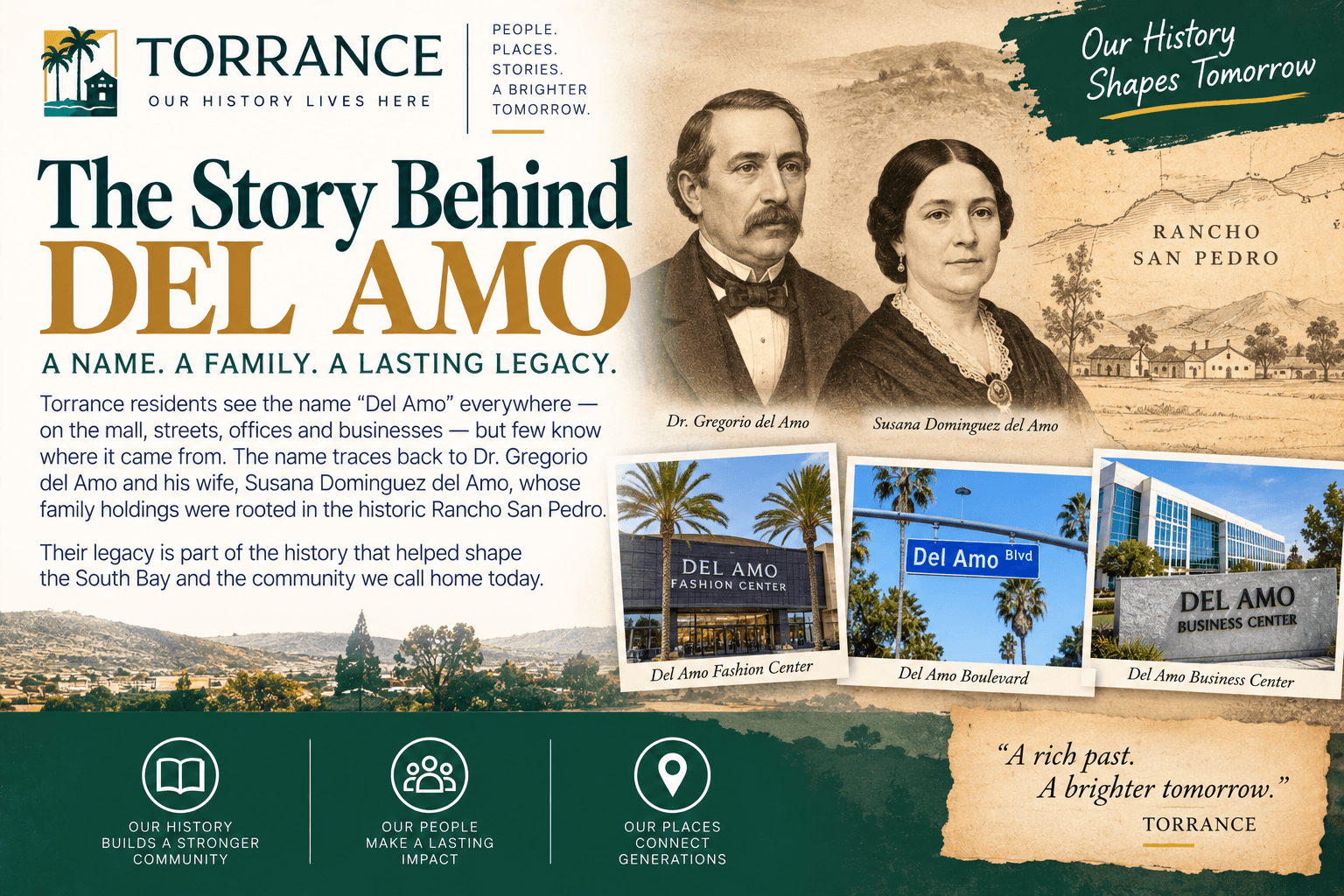
“Del Amo” is one of the most recognizable names in Torrance.
There is Del Amo Fashion Center, Del Amo Boulevard, Del Amo Circle, office buildings, businesses and entire areas of the city associated with the name.
But Del Amo was not invented as a shopping-center brand.
It comes from Dr. Gregorio del Amo and his wife, Susana Delfina Dominguez del Amo, members of a family deeply connected to the land that eventually became much of the modern South Bay.
Susana was an heir of Manuel Dominguez, whose family controlled portions of the enormous Rancho San Pedro, one of Southern California’s early Spanish land grants. The rancho originally covered more than 75,000 acres and included land that would eventually become part of Torrance.
In 1926, Gregorio and Susana established the Del Amo Estate Company to manage the family’s property holdings.
According to archival records at California State University, Dominguez Hills, Gregorio del Amo initially leased portions of the property to farmers. During the 1920s, the family increasingly moved toward commercial and industrial development as the South Bay began changing from ranchland and agriculture into a more urban economy.
That transition eventually helped make the Del Amo name part of Torrance’s commercial identity.
The original Del Amo Shopping Center opened near Hawthorne Boulevard and Carson Street beginning in 1959. A separate shopping complex developed north of Carson Street during the 1960s. The two centers were eventually connected, and in 1981 the combined Del Amo Fashion Center opened with roughly 3 million square feet and 355 stores, becoming the largest indoor shopping center in the country at the time.
For more than a decade, Del Amo held onto that distinction before the Mall of America opened in Minnesota in 1992.
That history explains why the name extends well beyond the mall.
“Del Amo” represents a link between Torrance’s rancho-era past, its agricultural period and its transformation into a major suburban commercial center.
So the next time you drive down Del Amo Boulevard or walk through Del Amo Fashion Center, you are seeing more than a familiar Torrance name.
You are seeing a piece of the South Bay’s land history that survived into the modern city.
External Link: Explore the Del Amo Estate Company historical collection |
0 Comments
Join the conversation
Be the first to comment
Share your thoughts above.