
Is It True What People Are Saying About Peptides? |
Peptides are being promoted for weight loss, healing, muscle growth and anti-aging. Some are legitimate medicines. Others are running well ahead of the science. |
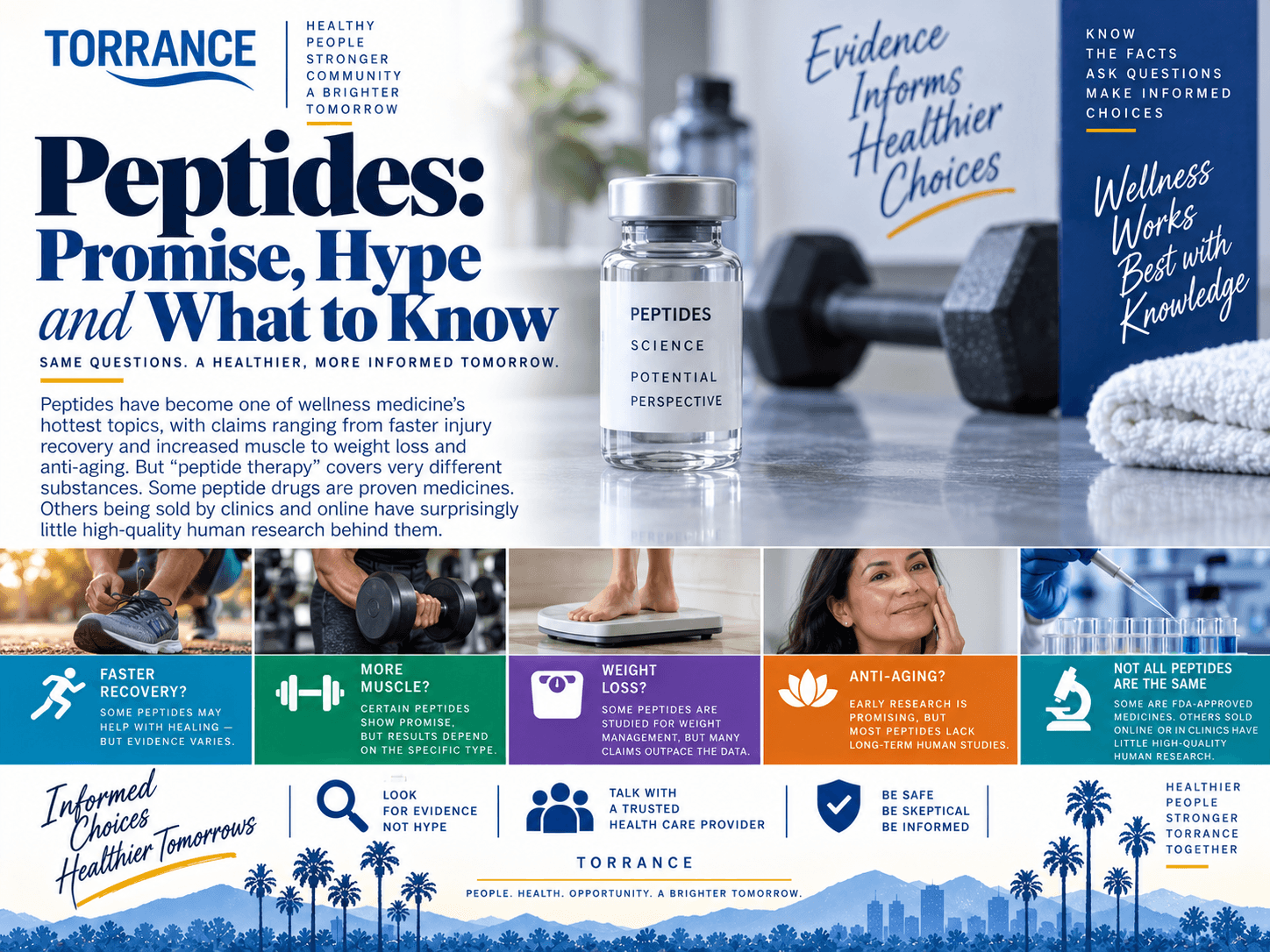
If you have heard friends talking about peptides lately, you are not imagining it.
Peptide injections and “peptide therapy” are increasingly promoted by wellness clinics, longevity practices, fitness influencers and online companies. Depending on whom you listen to, they may supposedly help burn fat, build muscle, heal tendons, improve sleep, increase energy, slow aging or speed recovery from injuries.
So, is any of it true?
The short answer is:
Some of it is. But the word “peptide” is being used to describe treatments with dramatically different levels of scientific evidence.
First, What Is a Peptide?
Peptides are small chains of amino acids—the same basic building blocks that make up proteins.
And peptides themselves are not fringe medicine.
Modern medicine already uses numerous peptide-based drugs. FDA-approved examples include semaglutide, used in medicines such as Wegovy and Ozempic; liraglutide; insulin-related therapies; glucagon; teriparatide for osteoporosis; and several other medications.
Those drugs have gone through clinical testing for specific medical uses.
That is very different from assuming that every substance called a peptide has also been proven safe and effective.
Where Things Get Murky
Much of today's excitement centers on substances such as:
BPC-157 — promoted for tendon, ligament, muscle and gut healing.
CJC-1295 — promoted for increasing growth hormone, muscle development, fat loss and recovery.
Ipamorelin — marketed for growth-hormone stimulation, sleep, body composition and anti-aging.
TB-500 — promoted for tissue repair and injury recovery.
These are the names increasingly appearing in gyms, online forums, wellness practices and social-media videos.
And this is where the science becomes considerably less impressive than the marketing.
BPC-157: Promising—But Mostly in Animals
BPC-157 may be the best example.
Researchers have found intriguing results involving tendon, muscle, ligament and bone healing.
The catch?
Most of those studies were conducted in animals, not people.
A 2025 systematic review examined 36 studies involving BPC-157. Thirty-five were preclinical studies and only one involved human patients. Researchers concluded that BPC-157 showed promise but that human safety remained unknown.
A broader 2026 sports-medicine review reached a similar conclusion: claims surrounding many emerging peptide treatments remain unsupported by strong human trials, despite encouraging laboratory and animal research.
That doesn't mean BPC-157 will ultimately prove ineffective.
It means we don't yet have the evidence required to confidently say that it works—or that long-term use is safe.
What About CJC-1295 and Ipamorelin?
There are similar questions here.
The FDA says available clinical data for CJC-1295 are limited and has identified reports that include increased heart rate and systemic vasodilatory reactions.
Ipamorelin has been marketed for weight loss, anti-aging, improved sleep and bodybuilding.
But after reviewing the available evidence, FDA scientists concluded that evidence supporting its effectiveness was limited and identified unresolved safety concerns.
Again, that is very different from saying researchers have proven these compounds useless.
It means the confident claims consumers sometimes hear are ahead of the evidence.
“Compounded” Does Not Mean FDA-Approved
This distinction is particularly important.
Some peptide products are obtained from compounding pharmacies.
Compounding is a legitimate part of medicine and can be valuable when a patient has a specific need that an FDA-approved product cannot meet.
But the FDA emphasizes that compounded drugs are not FDA-approved. The agency does not review each compounded medication for safety, effectiveness and quality before it reaches patients.
With injectable peptides, quality matters enormously.
Problems involving potency, contamination, peptide impurities or improper storage can create risks completely separate from whether the peptide itself eventually proves medically useful.
So Are Peptides the Next Big Thing?
Possibly.
Peptides are already an important part of modern medicine, and researchers are actively investigating many more.
Some of today's experimental treatments may eventually become tomorrow's proven therapies.
But there is an enormous difference between:
“Scientists see something promising here”
and
“This has been shown to make people younger, leaner, stronger and heal faster.”
Right now, many popular wellness peptides are much closer to the first statement than the second.
The Health Watch Bottom Line
If someone tells you “peptides work,” the next question should be:
Which peptide, for what condition, and supported by what human evidence?
That one question cuts through much of the hype.
An FDA-approved peptide medication prescribed for a condition it has been rigorously studied to treat is one thing.
An injectable substance promoted online for anti-aging or rapid recovery with little controlled human research is something very different.
Peptide science is real.
But not every peptide claim is.
And when the promised benefits sound almost too good to be true, the research—not the marketing—should get the final word.
Article Link: FDA: Safety Concerns With Certain Compounded Drug Ingredients |
0 Comments
Join the conversation
Be the first to comment
Share your thoughts above.